Hooded Eyes: How to Tell and the Makeup That Works
Hooded eyes have a fold of skin from the brow bone that covers the crease when your eyes are open. Put shadow above the crease, draw liner with eyes open and tightline instead of a thick line.
By the Beautify team7 min read
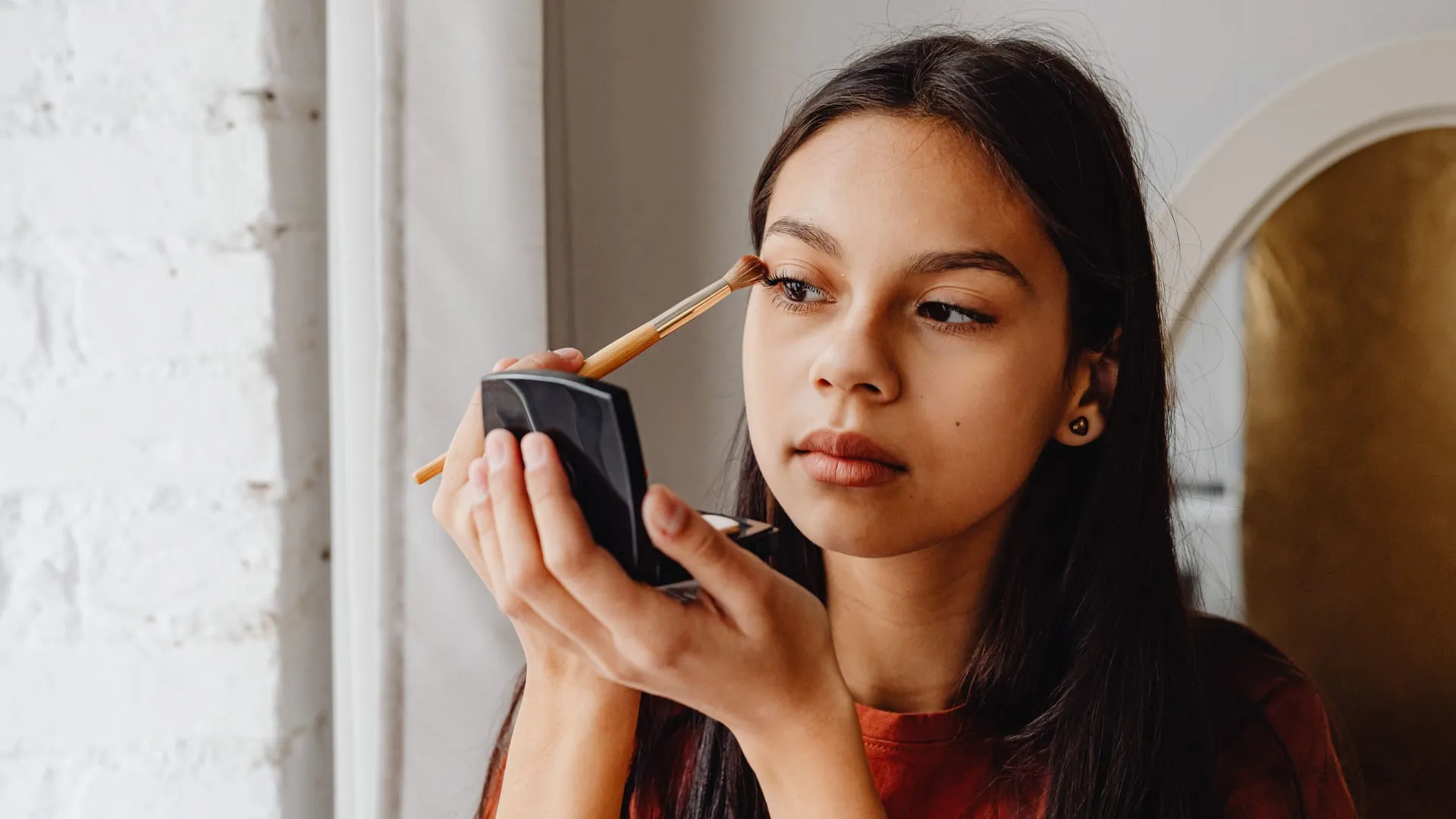
You have hooded eyes if, when you look straight into a mirror with your eyes open, you can barely see your eyelid because a soft fold of skin from under the brow drops over your crease. It is one of the most common eye shapes, and it becomes more common with age.
Hooded eyes are not a flaw to correct. They just change where makeup shows: anything placed in the crease or drawn with your eyes closed tends to disappear or smudge. This guide covers how to tell if your eyes are hooded (and how that differs from monolids and deep-set eyes), why hooding increases with age, and the eyeshadow, liner, mascara and brow techniques that work.
How can you tell if you have hooded eyes?
Your eyes are hooded if you have a visible crease when your eyes are closed, but a fold of skin from the brow bone covers most or all of it, and much of the lid, when your eyes are open.
Try this mirror test:
- Stand in front of a mirror in even light, with your face relaxed and your brows not raised.
- Look straight ahead with your eyes open normally.
- Find your lid. Can you see the smooth, mobile lid between your lashes and your crease? If you see a clear band of lid, your eyes are not hooded.
- Find your crease. Now close your eyes and feel or look for the crease. If you have a crease when your eyes are closed, but it is hidden behind a fold of skin when they are open, your eyes are hooded.
- Check the outer corner. Hooding often starts at the outer third, where the fold can rest close to or on the lashes. That is called partial or outer hooding.
What is the difference between hooded eyes and monolids?
The difference is the crease: hooded eyes have a crease that is covered by a fold of skin, while monolids have no visible crease at all.
On a monolid, the lid runs smoothly from the lashes to the brow without a fold, so the skin you see when your eyes are open is the lid itself. On a hooded eye, there is a crease, it is just hidden. In practice this changes technique: monolids work best with a gradient built up from the lash line, while hooded eyes need color placed above the crease so it shows over the fold. Some people have both, a low or partial crease with a slight hood, so use whichever technique shows best in the mirror.
What is the difference between hooded eyes and deep-set eyes?
Deep-set eyes sit further back in the eye socket under a prominent brow bone, while hooded eyes have extra skin folding down over the crease.
On deep-set eyes, you can usually still see the lid and crease when your eyes are open, but the area looks shadowed and the brow bone sticks out. On hooded eyes, the brow bone may be normal, but skin covers the crease. Deep-set eyes benefit from lighter, brighter shades on the lid to bring it forward; hooded eyes benefit from shadow lifted above the crease. You can find all seven shapes side by side on the eye shape page.
Why do eyes become more hooded with age?
Eyes become more hooded with age because eyelid skin loses elasticity, the connective tissue weakens and gravity pulls the loosened skin down over the crease.
The American Academy of Ophthalmology’s EyeWiki entry on dermatochalasis, the medical term for loose, redundant eyelid skin, describes it as a common sign of aging around the eyes in middle-aged and older people. Weakening of the membrane that holds fat inside the eye socket lets fat bulge forward too, which adds fullness to the hood. EyeWiki lists genetics and family history as the strongest risk factors, with higher body mass index, male sex, lighter skin and smoking as possible additional ones.
For most people this is purely cosmetic. If the fold of skin starts to block your side vision, or your lids feel heavy and tired, EyeWiki notes that a full eye exam is needed. See an ophthalmologist; that is a medical question, not a makeup one.
Where should eyeshadow go on hooded eyes?
Eyeshadow on hooded eyes should go slightly above your natural crease, placed while your eyes are open, so the color shows on the fold instead of hiding under it.
- Prime first. Hooded lids touch the skin above them, so shadow creases and transfers. An eyeshadow primer helps it last.
- Sweep a light matte shade from lash line to brow bone as a base.
- Open your eyes and look straight ahead. Place a medium matte transition shade just above where the fold sits, not in the crease you see when your eyes are closed. Ingrid-Marie Johansson, creative director of IsaDora, told Makeup.com to blend a deeper shade from the outer corner above the natural crease, with eyes open, so you can see when it becomes visible.
- Angle it up and out at the outer corner toward the end of the brow. This lifts the outer third where hooding is usually heaviest.
- Keep shimmer on the visible lid and inner corner. Matte shades recede and shimmer catches light, so matte on the fold and shimmer where the lid shows looks the most open.
| Do | Instead of |
|---|---|
| Place crease color above the fold, eyes open | Following the crease with eyes closed |
| Matte shades on the hood | Glitter or shimmer across the fold |
| Angle shadow up toward the brow tail | Dragging dark shadow down at the outer corner |
| Tightline the upper waterline | A thick line across the whole lid |
| Draw the wing with eyes open | Drawing the wing with eyes closed |
How do you do eyeliner on hooded eyes?
The two techniques that work on hooded eyes are tightlining, which defines the lashes without taking up lid space, and a wing drawn with your eyes open so it does not fold or kink.
Tightlining: Lift the upper lid gently and press a waterproof pencil into the upper waterline and between the lashes. The lashes look thicker, and nothing sits on the lid to be hidden by the hood.
The “bat wing” method for a winged liner:
- Look straight into the mirror with your eyes open.
- Mark the tip of the wing where you want it to end, angled toward the end of your brow.
- Draw a line from the tip back to the outer corner. On hooded eyes this line often looks broken or notched when your eyes are closed. That is normal; it straightens when your eyes are open.
- Connect to a thin line along the lash line.
- Open, look ahead and check. Fill any gaps with your eyes open.
Keep the line along the lash line thin. Thick liner disappears under the hood and then prints onto the fold when you blink.
What mascara and brow tricks help hooded eyes?
Curled, separated lashes and a lifted brow do as much for hooded eyes as shadow does, because they create space between the lashes and the fold.
- Curl your lashes before mascara, pressing at the base, so they lift away from the hood instead of hitting it.
- Use a waterproof or tubing mascara. Lashes touching the hood can smudge; waterproof formulas transfer less.
- Focus on the outer lashes to lift the outer third. L’Oréal educator Gabriel Almodovar, quoted by Makeup.com, recommends curling and loading up on mascara to make eyes look bigger.
- Highlight the inner corner with a champagne or pale shimmer to open the eye.
- Shape the brow with a slight lift at the arch. A brow that rises a little gives the eye more visible space; a brow pulled flat or low adds weight. A dab of light concealer under the arch sharpens it.
- Skip heavy lower liner at the outer corner, which drags the eye down.
These tips work for any makeup look, from no-makeup makeup to dramatic liner. If you want to try the trending styles, see siren eyes vs doe eyes vs fox eyes for how to adapt each one.
Where does Beautify fit?
Beautify is an iPhone app that identifies your eye shape from a selfie and gives eye makeup tips for that shape, so if your result is hooded you get placement advice like the techniques above. The same scan gives your face shape, skin type and eight scores out of 100, including one for eyes. Ten step-by-step makeup tutorials walk you through full looks, and the AI beauty assistant answers follow-up questions, such as which mascara formula smudges less on hooded lids. Beautify does not do virtual try-on. You can get the same answer for free with the mirror test above, or book a lesson with a makeup artist, who can show you the technique on your own eyes.
What matters most?
- Hooded eyes have a crease that is covered by a fold of skin when your eyes are open; monolids have no crease, and deep-set eyes are set back under the brow bone.
- Hooding is common at every age and increases as eyelid skin loosens; see an ophthalmologist if it blocks your vision.
- Do your makeup with your eyes open: shadow above the crease, a wing drawn straight on, and tightlining instead of thick liner.
- Curl your lashes, use waterproof formulas and give your brow a gentle lift.
Questions people ask
Can young people have hooded eyes?
Yes. Many people are born with hooded lids, and family genes are the strongest predictor of loose upper lid skin. Age makes hooding more noticeable, but it is a common eye shape at any age.
Can you have one hooded eye?
Yes. The two eyes are rarely identical, so one lid can fold lower than the other. Draw liner and place shadow with both eyes open, and adjust the lower side slightly so the two look even from the front.
What makeup works for hooded eyes and glasses?
Keep the shadow above the crease and the liner close to the lashes so the frame does not cut through your makeup. Lenses for farsightedness make eyes look bigger, so blend carefully; lenses for nearsightedness make them look smaller, so a slightly bolder lash line helps.